Science as an Universal Language: From Apollo-Soyuz to the International Space Station

José Luis Vázquez Poletti, Universidad Complutense de Madrid (Spain)
E-mail: jlvazquez@fdi.ucm.es
Web: https://dsa.ucm.es/jlvazquez/
(https://levocidisophia.it/2025/07/02/invited-paper-2/)
(https://www.doi.org/10.14672/10.14672/VDS20255IP17)
Abstractus
This article examines how science serves as a universal language through two emblematic missions: the Apollo-Soyuz Test Project (1975) and the International Space Station (ISS, 1998–present). It explores cultural, linguistic, and technological challenges overcome through international collaboration and educational initiatives such as ARISS and Astro Pi. The author highlights the role of cooperation in scientific advancement and in inspiring future generations of scientists, emphasizing the importance of preserving the ISS as a symbol of global unity.
Keywords: science, international cooperation, Apollo-Soyuz, ISS, space education
How we arrived here?
From July 14th to 20th, 2025, Amateur Radio on the International Space Station (ARISS)[1] organized an event that provides the perfect gateway into the topic I want to explore here. This remarkable organization inspires students worldwide to pursue careers in science, technology, engineering, and math by offering unique opportunities to communicate with the ISS crew via amateur radio.
The event was one of many Slow Scan TV (SSTV) transmissions, receivable by anyone under the ISS’s orbital path with a radio tuned to 145.800 MHz. For those without equipment, online receivers across the globe[2] make it possible to participate as well.
The sound of SSTV may remind “boomers” and “Gen Xers” (I belong to the latter) of the screeches of old fax machines (now “lost like tears in the rain” for younger generations). With free and open-source software, this sound can be decoded into commemorative “electronic postcards”. ARISS even issues diplomas to those who successfully submit at least one of these images.
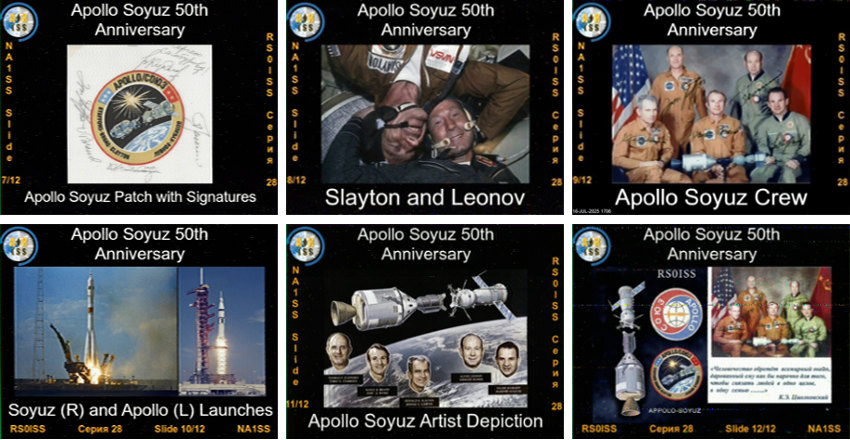
Figure 1. All the SSTV images devoted to the Apollo-Soyuz 50th Anniversary, emitted from the ISS from July 14th to 20th, 2025. Source: ARISS.
Activities like this are a fantastic excuse for learning: orbital mechanics (tracking the ISS and predicting passes), radio technology (antenna types and deployment), and computer science (signal processing and automation). And of course, a diploma issued by the ISS is always a reward worth chasing.
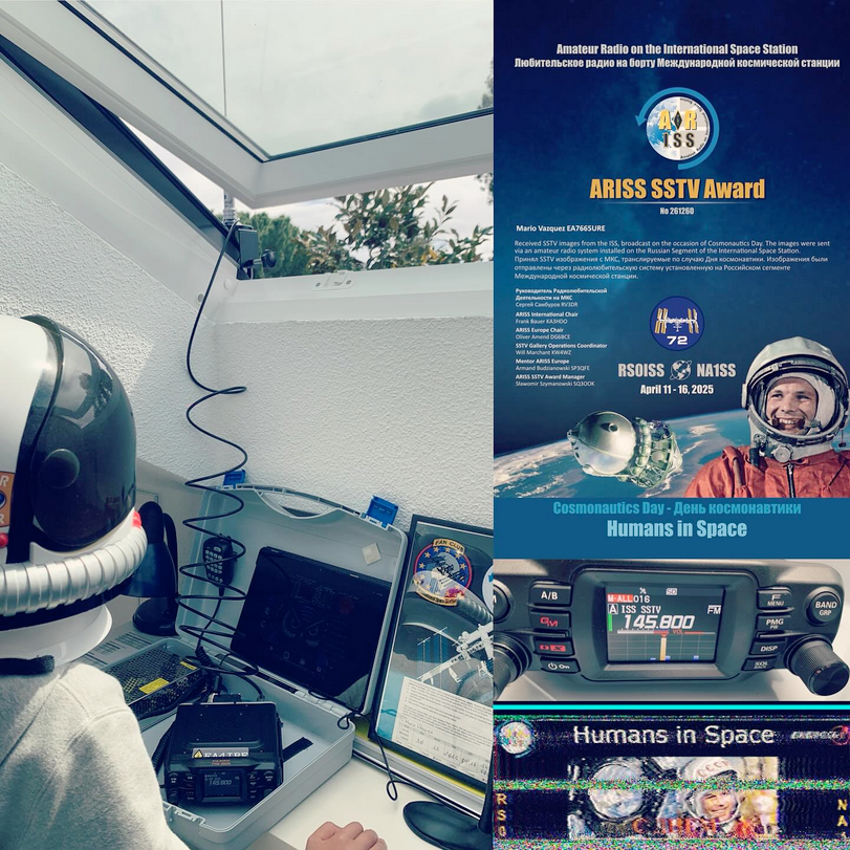
Figure 2. Illustration of the complete process, from receiving the radio signal to obtaining the diploma, demonstrated by my son (SWL callsign: EA7665URE) during a previous event dedicated to Cosmonautics Day 2025. Source: Own.
As you have seen, this event celebrated the 50th anniversary of the Apollo-Soyuz mission. For me, it also carries a timeless reminder: as we face global challenges today, Science is strongest when it transcends borders.
Apollo-Soyuz Test Project (1975)
In the middle of the Cold War, when political tensions were at their peak, American astronauts and Soviet cosmonauts shook hands in orbit. The Apollo-Soyuz Test Project was the first joint space mission between the United States and the Soviet Union. Two spacecraft docked in space, their crews exchanged gifts and carried out experiments, sending a powerful message: collaboration is possible, even between rivals.
But achieving this was far from simple. Several barriers stood in the way, and the first was language. Both crews had to take crash courses in each other’s tongue. Alexei Leonov, commander of Soyuz and the first human to perform an Extra-Vehicular Activity (EVA), later recalled with humor that they sometimes ended up speaking a “third language” due to Apollo commander Thomas Stafford’s unique pronunciation of the Russian r.
Initially, the plan was that each crew would simply speak their own language, expecting the other to follow along. Unsurprisingly, this proved ineffective. The turning point came when both sides agreed to switch: the Americans spoke Russian and the Soviets spoke English.
That willingness to yield made all the difference. It showed that cooperation was not just a matter of technology, but of attitude and trust. Yet language was only the first hurdle. An even greater challenge awaited: how to physically bring two fundamentally different spacecraft together in orbit.
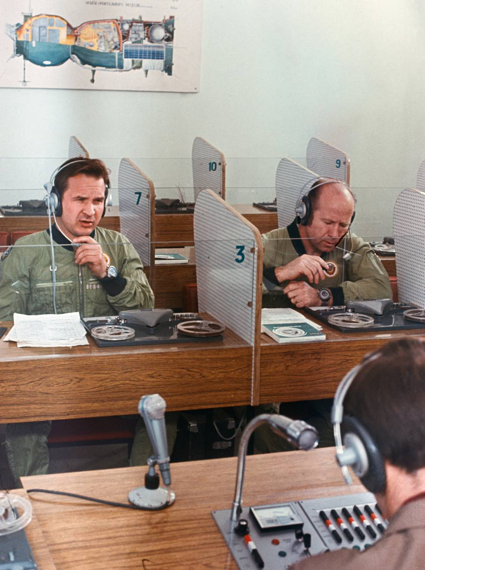
Figure 3. Kubasov and Leonov during English lessons. Source: Science Photo Library.
This challenge concerned specifically the docking mechanism, since the two spacecraft were, of course, incompatible. This required a remarkable joint effort by NASA and the Soviet Academy of Sciences. The result was the Androgynous Peripheral Assembly System (APAS). The choice of the word “androgynous” was not accidental: neither side wanted to be assigned the “passive” role in docking (a discussion we might leave to Freud). Beyond its symbolism, the APAS proved highly practical, and its later evolutions remain the standard for docking systems today, where both sides can act in both active and passive roles.
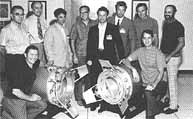
Figure 4. Mockup of the first APAS (APAS-75). Source: NASA.
Meanwhile, Cold War paranoia was never far away. The Americans were billeted in Star City, the Soviet cosmonaut training center, in quarters they suspected were bugged. Deke Slayton even referred to them as “rooms with ears”.
To test the theory, the crew loudly complained about the lack of a pool table. To their surprise, the very next day, a pool table appeared in their recreational bar.
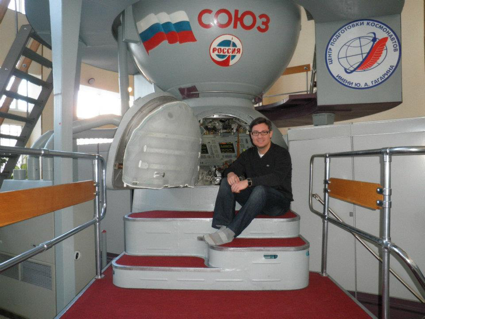
Figure 5. The “new” Soyuz simulator at Star City. Source: Own.
The lessons learned during Apollo‑Soyuz went far beyond docking mechanisms and language lessons. They demonstrated that even the most complex technological and cultural barriers could be overcome when trust, communication, and a shared goal were at the forefront. These principles became the foundation for the next leap in international collaboration: the International Space Station (ISS).
Unlike the short-duration Apollo‑Soyuz mission, the ISS is a long-term, continuously inhabited laboratory in orbit, built and operated by multiple space agencies from around the world. It embodies the spirit of cooperation first tested in 1975, proving that when nations unite under the banner of science, remarkable achievements become possible.
The International Space Station (1998–present)
Unlike the short-duration Apollo-Soyuz mission, the ISS is a long-term, continuously inhabited laboratory in orbit, built and operated by multiple space agencies from around the world. It embodies the spirit of cooperation first tested in 1975, proving that when nations unite under the banner of science, remarkable achievements become possible.
The ISS stands as one of the greatest symbols of what humanity can achieve together. Built and operated by NASA (USA), Roscosmos (Russia), ESA (Europe), JAXA (Japan), and CSA (Canada), it is a laboratory orbiting Earth, home to countless experiments that no single nation could have accomplished alone. Its very existence proves that cooperation in science is not only beneficial, but essential.
From the very beginning, the station demanded unprecedented levels of coordination. Modules built on opposite sides of the planet had to be designed to fit perfectly together in orbit. Astronauts and cosmonauts train for months (often years) in facilities across several continents, learning not only technical procedures but also how to adapt to each other’s languages, traditions, and ways of working.
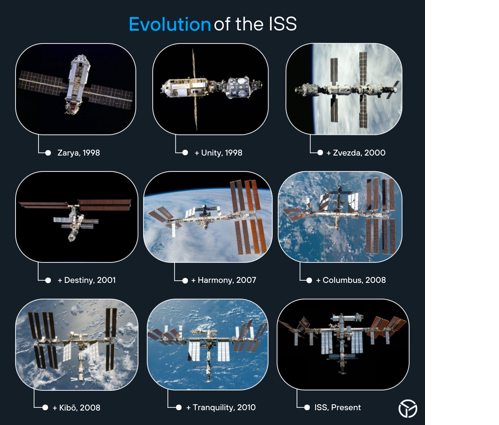
Figure 6. Evolution of the ISS over the years. Source: Gravitics.
Since November 2000, when the first permanent crew took residence, the ISS has been continuously inhabited, becoming a true “home in the sky”. Over the years, it has hosted astronauts from 20 different countries, conducting thousands of experiments in fields ranging from biology and medicine to physics and Earth observation. Many of these studies directly benefit life on Earth, from the development of new medical treatments to a better understanding of climate change.
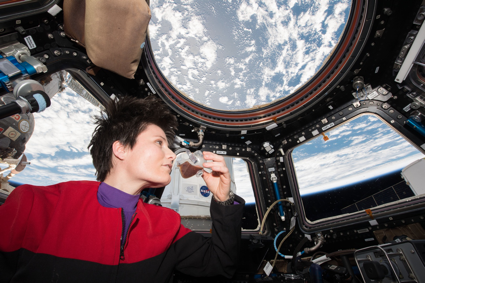
Figure 7. Italian astronaut Samantha Cristoforetti enjoying a cup of coffee while dressed as Captain Kathryn Janeway (Star Trek: Voyager) at the ISS Cupola. Source: NASA.
But the ISS is also a classroom without borders. Programs like Amateur Radio on the ISS (ARISS) allow students worldwide to talk directly with orbiting astronauts, sparking curiosity and inspiring the next generation of scientists and engineers. Beyond this, initiatives such as the Astro Pi Challenge, organized by the European Space Agency (ESA) and the Raspberry Pi Foundation, enable young students to write computer code that actually runs on the ISS. From climate observations to experiments in physics, these student-designed programs demonstrate that the station is not just for astronauts or scientists, but for everyone on Earth.
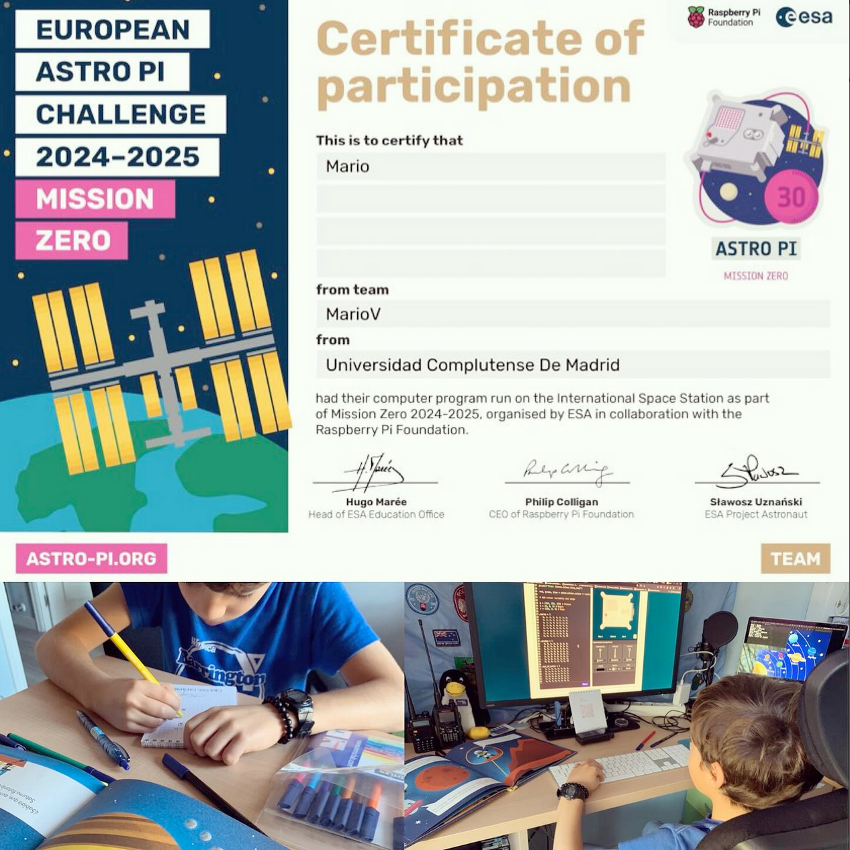
Figure 8. My son participating in the Astro Pi Zero Challenge 2024–2025. The diploma even indicates the exact location above Earth where his code was executed. Source: Own.
Of course, the station has not been free of political tensions. At times, relations between its partner nations on Earth have been strained. Yet, above our planet, cooperation has prevailed. Day after day, astronauts work side by side, proving that science can succeed where politics falters.
The ISS, then, is not just a marvel of engineering, it is living proof of the power of international collaboration. It carries forward the legacy of Apollo-Soyuz, showing that when humanity dares to cooperate, we can build not only spacecraft, but bridges across cultures, ideologies, and generations.
But today, the future of the ISS is uncertain. Russia has announced its intention to step back from the project, and discussions about how and when to retire the station are already underway. Some argue that new programs, such as the Artemis missions to the Moon or future lunar gateways, should take priority.
Yet abandoning the ISS too hastily would mean losing something far greater than hardware in orbit. The station is not only a scientific laboratory, it is a symbol of what humanity can achieve when it chooses cooperation over confrontation. For more than two decades, it has been proof that nations with very different agendas can come together, work side by side, and produce results that benefit all of us on Earth. Preserving it means preserving not just a laboratory, but a vision of humanity working together above the very planet that sustains us.
Conclusion
Although the uncertain fate of the ISS may leave a bitter aftertaste, I remain hopeful. I am confident that other stations (or new infrastructures) will emerge, allowing humanity to continue enjoying science from orbit.
This is because science is, at its core, a universal language. It allows us to ask questions about the world and the universe in a way that transcends politics, ideology, and nationality.
I have had the incredible privilege of working in international collaborations where scientists from diverse backgrounds, languages, and cultures united under a common goal. What struck me most (especially in the space missions I had the opportunity to participate in) was how quickly political or cultural differences faded when the focus was on solving a scientific problem. Equations, data, and experiments spoke louder than any differences, and friendships often grew in parallel with the science.
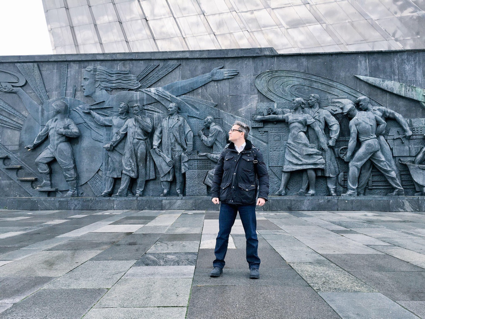
Figure 9. Detail of the base of the Monument to the Conquerors of Space (Moscow), showing the many arts and crafts that contributed to space exploration. Source: Own.
History teaches us that cooperation unlocks discoveries that no single nation could achieve alone. As we look ahead, it is crucial to keep science free from political divides. For in science, we find not only knowledge but also unity, and that may be humanity’s greatest achievement of all.
LLAP
Bibliography
· NASA. Apollo-Soyuz Test Project: Mission Report. Washington, DC: NASA, 1975.
· NASA. International Space Station: Program Overview. Washington, DC: NASA, 2023.
· Vázquez Poletti, José Luis. Science as a Universal Language: From Apollo-Soyuz to the International Space Station. Universidad Complutense de Madrid, 2025.
· European Space Agency (ESA). Astro Pi Challenge Guide. ESA Education, 2024.
· ARISS. Amateur Radio on the International Space Station: Program Information. 2025.
· Leonov, Alexei. Two Sides of the Moon: My Life in Space. New York: Little, Brown, 1997.
· Slayton, Deke, and Michael Cassutt. Deke!: U.S. Manned Space from Mercury to the Shuttle. Washington, DC: Smithsonian Books, 1994.
· Kranz, Gene. Failure Is Not an Option. New York: Simon & Schuster, 2000.
· Logsdon, John M. The Partnership: A History of the Apollo-Soyuz Test Project. NASA History Series, 1978.
· Siddiqi, Asif A. Challenge to Apollo: The Soviet Union and the Space Race, 1945–1974. Washington, DC: NASA History Office, 2000.
· Gravitics. ISS Module Evolution. 2025. https://gravitics.com/iss-evolution
[1] https://www.ariss.org/, last website visit: 28/08/2025
[2] http://websdr.org/, last website visit: 28/08/2025