Invited paper 6
Diritti in capo agli autori

Pat Patfoort. OSCE, Consiglio d’Europa, Nazioni Unite, antropologa e biologa, formatrice alla nonviolenza, https://www.patpatfoort.be/
E-mail: pat.patfoort@glo.be
(https://doi.org/10.14672/VDS20256IP25)
Here the 6th number of the journal.
Abstract
This article presents and examines the MmE model (Major–minor–Equivalency) as a theoretical and practical framework for understanding and transforming conflicts at interpersonal, organizational, and geopolitical levels. The methodology is conceptual-analytical and application-oriented, based on a systematic comparison between two fundamentally different ways of dealing with differences: the Major – minor (M–m) model, identified as the structural root of violence, and the Equivalency (E) model, which underpins nonviolent and constructive communication. Through illustrative case studies drawn from family life, workplace relations, and international conflict, the article demonstrates how the M–m model inevitably generates the three mechanisms of violence -escalation, chain, and internalization – whereas the E model enables the transformation of disagreement into a creative process of mutual understanding.
In comparison with existing approaches to conflict management, the article shows that many traditional and even mediative frameworks remain implicitly grounded in competitive, argumentative, and dualistic logics. The main innovation of this contribution lies in the operational introduction of “foundations”- such as needs, fears, values, motivations, and emotions – in place of arguments, and in the articulation of a process that prioritizes relational quality and procedural depth over solution-driven compromise.
The conclusions indicate that the Equivalency model allows actors to move beyond winner–loser dynamics, offering a coherent framework for reducing violence, enhancing individual and collective well-being, and generating solutions that are sustainable and acceptable to all parties involved. Future developments include the systematic application of the MmE model in education, leadership training, professional mediation, and large-scale conflict prevention and peacebuilding processes.
Keywords: Conflict transformation, Nonviolence, Constructive communication, Major–minor model, Equivalency model
I. The MmE model or Major-minor-Equivalency model
1. The Major-minor model
When there are differences between people (individuals or groups), differences in characteristics, points of view, interests, habits, values, feelings, etc, so easily people get on basis of them into the Major-minor model. This happens under the delusion that there is no other way to deal with differences.
In the Major-minor model each tries to present its own characteristic or behavior or point of view as better than the one of the other. Each tries to be right, to dominate, to win. Each tries to put oneself in the M-position, and the other person or group in the m-position. Most of the time this doesn’t happen consciously and wished. And this can happen with many different means: in a nonverbal way (facial expression, ironic smile, gestures, turning one’s back), with words (negative criticism, judgments, labeling, insults), with the body (punching, cuffing on the ears, kicking, biting), with an object (any daily used object, a broken bottle, a stick, a knife, a gun).
As nobody likes to be in a minor-position, people want to get out of it and put the other one in the m-position and so oneself in the M-position.
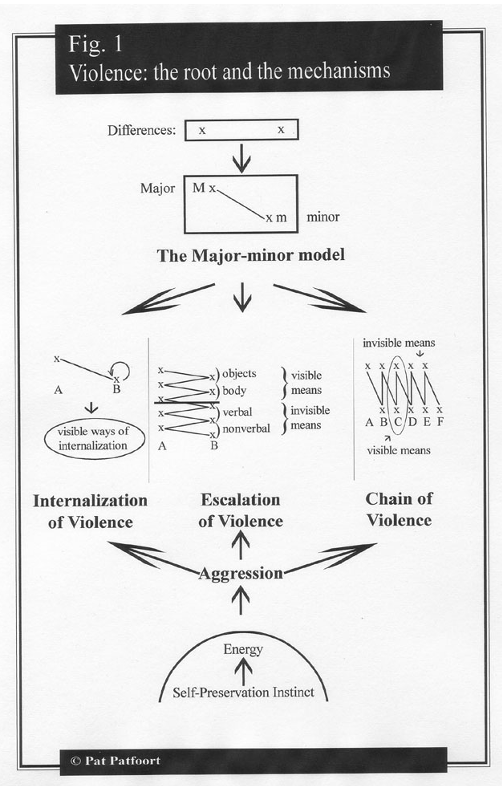
The consequences of this are the three mechanisms of violence (see fig.1):
a. The escalation of violence: putting oneself into a Major-position against the person who first did put him- or herself into the Major-position.
Illustrations:
– In a couple, Renato and Clara: Renato starts to wash the dishes, Clara says he should use more detergent, he answers she shouldn’t put her nose in his activities, she adds she knows it’s better to use more, he throws a plate in the water and shouts she just can do it herself if she all knows it better, and so it can continue to escalate.
– Between a parent and a child: Mam says Dino has to eat his soup, but Dino doesn’t eat. Mam says if he doesn’t eat his soup, he won’t get dessert. Dino says he anyway wasn’t going to eat dessert, it’s disgusting. Mam shouts: “If you don’t eat your soup, you won’t go to the swimming lesson!”. Dino snickers: “Hm! You don’t want me to drown, do you?”
b. The chain of violence: putting oneself into a Major-position against a third party.
Illustration:
Stefano had a bad day at work: he didn’t feel appreciated at all but only criticized although he feels he did lots of efforts to do well his work. When he returns home, he drives quite aggressively, so that another driver, Bernardo, needs very suddenly to brake not to hit his car. Bernardo is furious: he almost had an accident! When he gets home he immediately complains to his wife she is not ready with the meal. She then shouts at one of the children he is not doing his homework. The child hits his sister, etc.
c. The internalization of violence/aggression: when one cannot put oneself into a Major-position either against the person by whom one felt put in a minor-position or against a third party, one turns the available energy to defend oneself against oneself.
This can lead to depression, psychosomatic diseases (anorexia, migraine, eczema, ulcer, cancer), self-mutilation, drug addiction, suicide.
The M-m model is at the basis of these three mechanisms of violence. So, we call it the root of violence.
Where does the energy to get out of the m-position come from?
Behaving following the M-m model is so usual, seems so normal, that people often have the impression this is the only possible way, even think that this fits with the natural impulses of the human being, with the human instincts.
Now, what is inherent to the human being, is indeed at the basis of the transition from the start situation of two different points to the M-m model. It is the instinct of self-preservation or survival instinct that brings us to want to get out of the m-position, which produces energy to do so. The need to protect and to defend oneself is indeed inherent to human beings. But to do this following the M-m model is absolutely not inherent to the human being. This way is only one of the possible ways to achieve this. It is the way that on first sight seems to be the easiest one, and (probably therefore) also the one that in most human societies is taught from childhood on, and that afterwards continues to be built up and fed in all possible ways.
So not the aggression is inherent to human beings, as often is said, but what’s at the basis of it: the self-preservation instinct.
The instruments of the M-m model
Now we shall more particularly discuss situations where the two different points of the startsituation are points of view. Two (or more) parties have different points of view, they disagree. When the M-m model is used, that situation is known as a “conflict”.
In the M-m model the instruments used are what we call arguments. They are put forward to try to be right, to win.
There are four important kinds of arguments:
1) the positive arguments: one presents positive aspects of one’s own point of view, to move oneself up toward the M-position;
2) the negative arguments: one mentions negative aspects of the point of view of the other person, to push down the other person toward the m-position;
3) the glorifying arguments:one says positive aspects about oneself, again to push oneself up (“I never should say something like that!”, “I did do all those good things for him.”)
4) the destructive arguments: one cites negative aspects of the other person, to push the other person even more down to the m-position. Among these devices are racist, ageist and sexist remarks. A way in which another differs -skin color, youth or age, gender- will be presented as negative and used to devalue the other’s point of view, a view usually unrelated to the attribute referred to.
Using arguments is a superficial feeding of the situation. They stimulate an escalation of the conflict, feed the fire so to speak. Both parties use whatever they can find to make their own point of view stronger in opposition to the one of the other and to surmount it. One simply expands the conflict from above, feeding fuel to the fire.
2. The model of Equivalency
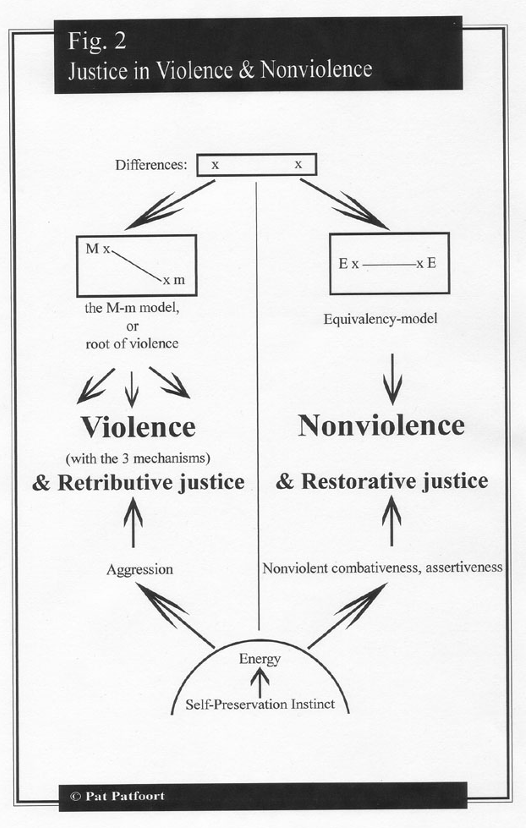
Another way to deal with the start situation of two different points, is the Equivalency-model or E-model (see fig.2). This model is at the basis of Nonviolence. This model also responds to the instinct of self-preservation of the human being. The E-model, the nonviolence, indeed also permits us to get out of the m-position, to defend and to protect ourselves, but not at another’s expense, not against someone, not attacking, as it is the case with the M-m model.
So, there are several ways to deal with differences between people. In a broad way we can make the distinction between
– on the one hand the destructive or violent way, the M-m model or Major-minor model;
– on the other the constructive or nonviolent way, the E- or Equivalent model.
The start situation by itself, the one of differences, doesn’t contain any problem, is not a conflict. It becomes a conflict when we put the differences into the M-m model.
Most people never learned about the existence of this distinction between the destructive and the constructive way, and even less about how to make concrete the constructive or nonviolent way. Too often people only get interested in knowing more about it when they are in the middle of a crisis, as well on the personal as on the societal level. Even if it’s still possible even then to learn about and to make conflict transformation concrete, it’s as a matter of course much harder in a middle of a crisis.
The instruments of the E-model
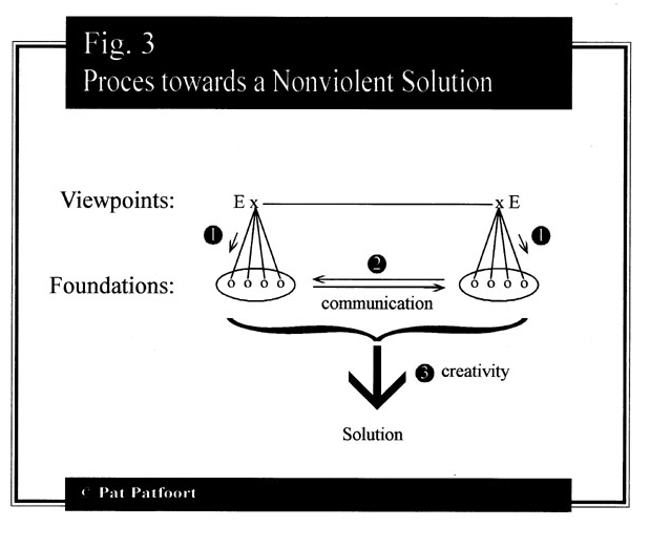
By contrast with the instruments used in the Major-minor system, the Equivalency model works with foundations, not arguments. As the word indicates, foundations are the underlying factors of both points of view (see fig.3).
They are the reasons why both parties have the points of view they do: their motivations, needs, feelings, interests, objectives, values, habits, etc. These elements can be either intellectual-rational or emotional. They are revealed through “Why” questions: “Why do I have this point of view?”, “Why does this other have his or hers?” Through exploring foundations in the E-model, one gains an opportunity to understand and to work on the conflict in depth rather than simply to be stuck in the M-m model pattern of feeding it at the surface. Foundations of different points of view are often not expressed. People may even not be conscious of them. Nevertheless, they are present, and identifying them is essential.
Resolving a conflict in Equivalency
Disagreement is handled in totally different ways by the M-m and E models. With the M-m model, there are only two possibilities. Either I am right or you are. We are in a two-dimensional system and each solution proposed or reached stimulates the same kind of reaction: “You see? I was right!” or “Who did win finally?” But often the M-m model doesn’t offer any out way at all: every time we defend ourselves we do this in an attacking way, by which another person is provoked to defend him or herself, again in an attacking way, again provoking us or another person. And so, it goes on.
By contrast, the E model leads us to innumerable solutions, which emerge from a way of thinking which transcends the two-dimensional restriction. They are created by understanding and respecting all of the foundations of both parties involved in the conflict.
While with the M-m model finding a solution is predominant, with the E-model the process by which one finds it is most important (see fig.3). The people in conflict enter that process by revealing the foundations of both sides, acknowledging and respecting those of the opponent as much as one’s own, then following a series of steps toward solution.
II. Using the MmE-model to get out of fighting towards constructive communication.
1. At home, the situation in a couple, about tasks in the household
Roberto and Lena are a couple. Roberto is a teacher who finishes work earlier than his wife Lena. Lena is director of a company.
There is often a lot of discussions and even fighting between Roberto and Lena about the tasks in the household: she would like him to have done the dishes before she gets home, but he does’t want it.
So, the fighting is like following:
Lena: “You are incredible! It’s so logical you do them; you have more time at home than I do!” (positive argument)
Roberto: “Yóu are incredible! You think that’s the only thing to do at home! You don’t see all I’m doing when I come home!” (positive argument)
Lena: “Doing things with the children doesn’t take a lot of time, it just takes five minutes!” (negative argument)
Roberto: “Well, if you only take five minutes for everything that needs to be done with the children after school, then you are not a good parent!” (destructive argument)
Lena: “What! I spend much more time with the children than you! Who is the good parent here?!! When I compare with other mothers, I see I’m taking much more care of my children than they do!” (glorifying argument)
Etc.
Every time they say harder things to one another, use more destructive arguments, are hurting one another more. This is the Major-minor way.
The Equivalent way is using foundations, like following:
| Roberto: I don’t want to have done the dishes before you come home from work. | Lena: I want you to have done the dishes before I get home from work |
| 1. I feel good when I have plenty of time to pick up the kids. 2. I need to put the children first in order to feel like a good parent. 3. I feel it’s more fun to be with the children than to do the dishes. 4. I’m afraid that you will see me as less of a man when I do the housework while you are making a living. 5. I need time to reflect about my work while it’s still fresh in my mind. 6. I’m afraid not to do a good job as a teacher and loose respect. 7. I’m afraid that you don’t value my job as much as your own. 8. I need to feel that we divide the workload in a fair way. | 1. I’m afraid the whole evening will be ruined by housework. 2. I need to be assured while at work that when I come home, I will have some time to relax. 3. I need to feel that you understand the heavy workload I have. 4. I’m afraid you take it for granted that I do the housework. 5. I feel good when we have quality time together. 6. I’m afraid to lose contact with the children. 7. I find it difficult to believe that you are as busy at home as I am at work. 8. I need to feel that we divide the workload in a fair way. |
So, they don’t use arguments anymore, they take care of only using foundations. They listen to the foundations of each other in an open and respectful way, they don’t judge or criticize the foundations of each other.
These are the two first steps of the process of Equivalency (see fig.3). At this point they shouldn’t be thinking of the third step of a solution. This will come later. Now they first have to discover and express their own foundations, and listen respectfully and actively
to the ones of the other one, so gathering all foundations together. And let this settle.
The relationship is becoming completely different in this way, from Major-minor to Equivalency, from fight to constructive communication, from aggression and hate to love, from misery to well-being.
2. In the workplace, between a boss and an employee
In a company there is an employee who has a difficult time with the fact his boss is often yelling at the employees. He feels put in a minor-position by the boss and feels very bad because of that. He doesn’t know how to get out of this m-position, he doesn’t dare to say anything about it to the boss. But meanwhile he is wasting away, completely devastated, not being able to do his work well anymore, not having any joy anymore in his work. It won’t take long he will have either a psychosomatic disease or a burnout, or in the worst case the employee will commit suicide (internalization of violence, the third mechanism of violence).
In this case, if the employee cannot work anymore, the boss (and others probably) will also be put in a minor-position (escalation of violence, the first mechanism of violence).
On top of what happens with the boss and the employee, there is probably also a lot of gossip among the other employees, consisting of arguments of all kinds, either against the boss or against the employee.
This is unfortunately a typical and too common situation of Major-minor that can lead to dramatic consequences. But this can be avoided if the situation is handled in an Equivalent way.
Therefore, once more, there should be a communication on basis of foundations, between both, or probably better in this case with the help of a third party, a mediator in Equivalency.
Then the foundations could be the following:
| Employee: I want my boss to stop yelling at the employees | Boss: I don’t stop yelling at the employees |
| 1. I need to work quietly 2. I don’t understand what he wants 3. I have the feeling that he doesn’t respect us 4. I find that contradictory with our type of work 5. I am afraid that this will cause me embarrassment in front of clients 6. I am not able to express my ideas 7. I can understand without yelling 8. I am convinced that methods other than yelling exist 9. I have ear problems 10. I have the feeling that yelling makes the workplace tensed | 1. I have the feeling that no one understands me 2. I see many mistakes 3. I feel angry and helpless 4. I think that yelling enhances performance 5. I have many workers, and I need them to respond quickly to work 6. I find it difficult to change my attitude 7. I take psychotropic drugs 8. I have personal stress/tension 9. I find it difficult to see someone more powerful than me 10. I have the feeling that they look at me aggressively 11. I get tensed by the situation in our country |
So, they should first discover and express their own foundations and listen to the foundations of each other in an open, active and respectful way, that means they should not judge or criticize the foundations of each other, not even a derisive smile, not wanting to discuss or object to any. It doesn’t mean people have to think and feel like the other ones or agreeing with their point of view. This is not always easy. People have to learn to do that, we were not educated to do that. So, it can take some time.
These are the two first steps of the process of Equivalency (see fig.3). It is clear that just going through these two steps, without even thinking of ‘a solution’ (third step), is already going to change the relationship a lot, and also how the two people think about the situation and about themselves. It can help them to decide to change some of their habits and attitudes (this is not the same as other people trying to change them, their habits and attitudes, this is Major-minor!)
The relationship is becoming completely different in this way, from Major-minor to Equivalency, from fight and misery to constructive communication, well-being and even production improvement.
III. Using the MmE-model to get out of fighting and war towards constructive communication and peace.
In February 2022, Russia did invade Ukraine, Russia did start a war against Ukraine. The start of this war, this invasion, was a (big) step in an escalation of violence (see fig.1). This escalation still goes on, with devastating consequences, many dead and injuries, significant material damage and international sanctions against Russia.
There is talk of enemies, good and bad ones, right and wrong ones, winning and losing, make concessions, loss of face, taking away, occupation, conquests. That’s all Major-minor language, the Major-minor way to look at this situation.
How could Equivalency look like?
We choose the moment when the war started, so in 2022 [1].
| We don’t want Russia to start a war against us | We want to start a war against Ukraine |
| 1. We are afraid to loose our lifes, our health (e.g. being handicapped, stressed), our properties, all we did built 2. We are afraid to loose loved ones, a son, a husband, a sweetheart, a dear friend 3. We are afraid Russia will occupy us, and so we would loose the Western values and habits, and the democratic living environment 4. We feel good with these Western values and habits 5. We consider that we are a sovereign country, and that attacking a sovereign country is against the rules 6. We have the feeling the people in Ukraine are content 7. We feel hurt in our pride 8. We don’t know how the European Union will react in case of a future attack by Russia, because we are not (yet) members of the NATO 9. We fear that we shall loose access to our ports and our raw materials 10. We feel so sorry for the soldiers, both Ukrainian and Russian soldiers, who are all children or parents, and are forced to take sides 11. We are afraid to loose eastern parts of our country 12. We fear that violence and war only create losers. 13. We fear that the distress can have serious consequences that continue to have an impact even after the war is over. 14. We fear that future generations will be haunted by this. | 1. We feel unsafe 2. We are afraid that Ukraine will become democratic, like other Eastern European countries. 3. We are afraid of the impact this will have on Russia and our elite. 4. We have seen that the relationship between Ukraine and NATO has grown stronger since 2014. 5. We feel unsafe because after the Cold War, NATO remained in place while the Warsaw Pact was dissolved, and NATO even expanded eastwards. We feel that endangers our existential national security interests. 6. We felt betrayed because we were promised that this would not happen. (Secretary of State James Baker, 1990). 7. We felt humiliated after the Cold War when we were not accepted into Europe on an equal footing with other countries. 8. We consider Crimea to be Russian (Soviet leader Khrushchev gave Crimea to the Ukrainian Soviet Republic in 1954). 9. We still regret all we have lost after 1991, we were a superpower, we feel that our identity has been compromised. 10. We consider Ukraine and Kiev to be the cradle of Russia, where Russia originated. 11. We would be able to use Ukraine’s ports all year round, unlike ours, which can only be used during certain periods. 12. We tried to bring about a pro-Russian regime change in Ukraine in 2022 and failed (a method often used by other countries like the US). 13. We see that eastern Ukraine was leaning towards Russia and that since 2019, language legislation has given Russian speakers fewer rights. |
If we would continue the analysis of the foundations, we surely would find many more foundations. This is only a beginning of the analysis.
Just like in the two other (personal) cases, the ways to look at the situation, the tools used to communicate, are very different in the Major-minor way and in the Equivalency. Obviously also the consequences and the results.
In Equivalency there is no question of concessions or compromises, but the objective is on basis of constructive communication and creativity to build real solutions, that are acceptable for all parties, on basis of all foundations. In this way it’s really possible to get out of misery, fighting and war towards well-being and peace.
_______________________
[1] These lists of foundations were set up with the help of Prof. Tom Sauer, Professor in International Politics at the University of Antwerpen (B), and two members of my organisation ‘De Vuurbloem’ (Center for Nonviolent Conflict Management) in Brugge (B), Etienne Carrette and Marie-Jeanne Vanrobaeys.